Action Merging
![[object Object]](https://avatars.githubusercontent.com/u/455246?v=4)
BuildBuddy's remote execution engine merges in-flight executions of identical actions to save our users time and resources. In this blog post, we'll explain why action merging is important, how it works, and some fun stuff we've learned over the years running our implementation in production.
Overview
Caching action results is one of the performance optimizations at the heart of Bazel. Unfortunately, neither the local nor remote Bazel caches provide a mechanism for sharing the results of pending executions. That means that if Alice submits a backend change that requires running BigSlowTest, then Bob submits a small frontend change while Alice's BigSlowTest is still running, Bob will have to run BigSlowTest too. This makes Bob's invocation slower and might also waste external resources like simulator licenses or quota.
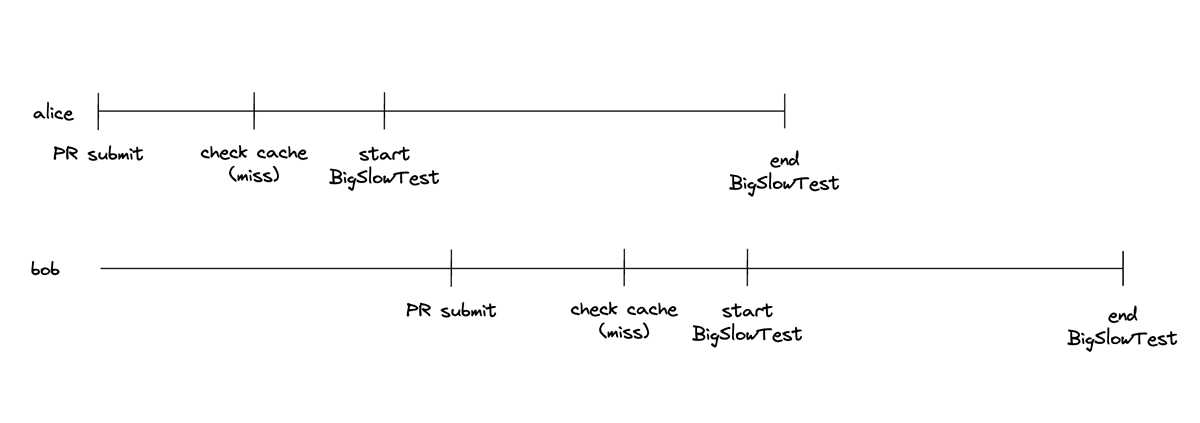 A timeline of Alice and Bob's unmerged BigSlowTest executions.
While this might sound contrived, the action merging system described below merges >1,000 actions per second in production at peak today saving some long-running tests almost 3 hours. We are not the first to do this, Stripe has blogged about their internal solution to this problem here.
Background
Actions and Executions
Actions are the units of work Bazel runs as part of a larger invocation. An action might be a compile or link command. Every action has an ID, called the Action ID, which is a hash of the action’s definition (command, environment variables) and all inputs.
g++ your_file.cpp -o your_program_name
Executions are runs of a single action, identified by a unique ID called an Execution ID that is generated when the execution starts. There will always be exactly one action per execution, but there could be zero, one, or many executions of an action.
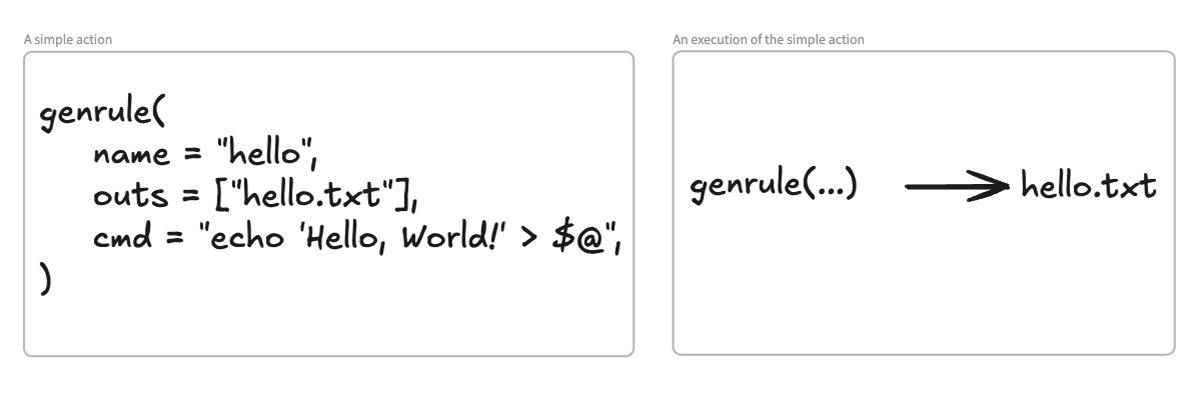 A simple action and an execution of that action.
BuildBuddy
BuildBuddy's remote cache and remote execution is primarily implemented by two services: stateful "apps" that store and serve the cache, interact with databases, and perform scheduling; and stateless autoscaling "executors" that run remote executions. BuildBuddy uses the Sparrow scheduling algorithm to schedule remote executions.
Each executor maintains a queue of tasks to execute and when a task reaches the head of the queue, the executor tries to claim and run the task. Claimed tasks are recorded in the invocation database so they're visible in the UI. When an execution finishes, it is recorded along with finalization data (like statistics) in the database.
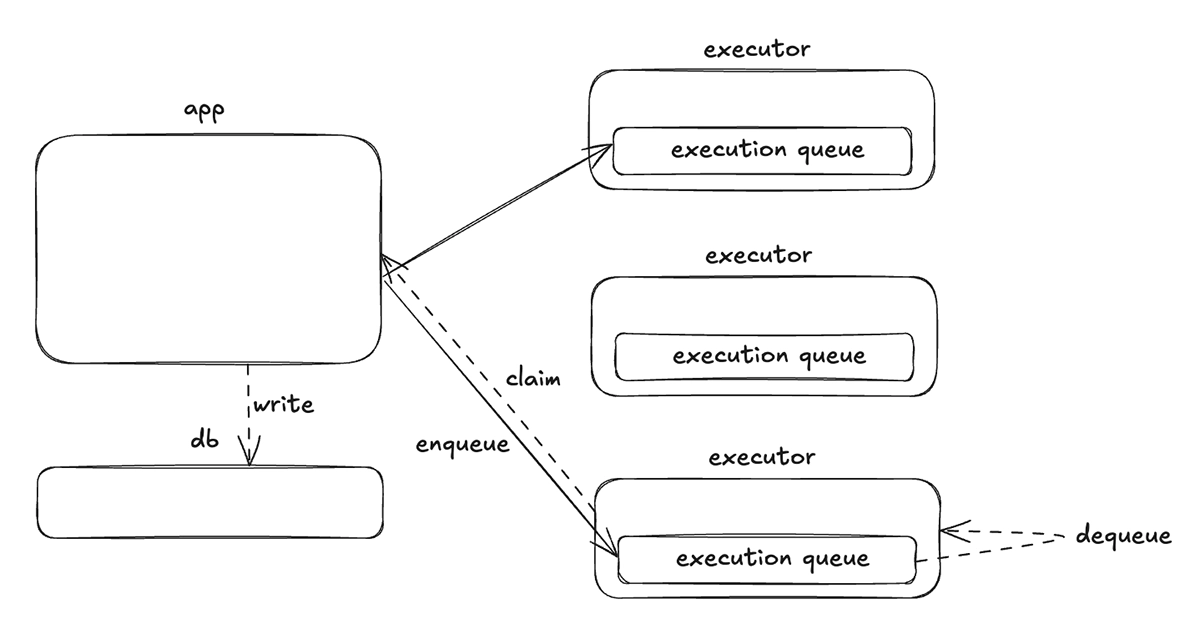 A simplified overview of BuildBuddy's architecture and scheduling.
Details
Returning to the example above, Alice and Bob are both executing the same Action (same action ID!) but they have independent executions (different execution ID). To get a result sooner, Bob could reuse Alice's BigSlowTest by waiting on her Execution ID. At the simplest level, that's how action merging works, but the devil is in the details.
As we dig into the edge cases, let's call Alice's execution the "primary" execution and Bob's the "merged" execution.
Queued Executions
We store all action merging data in Redis. While we could store it in the database, it's written frequently and not critical for correctness, so we keep it in Redis to reduce database load. This data consists of a bidirectional mapping between the Action ID and the primary Execution ID for each pending execution, as well as a few other things. Because executions can disappear from the scheduler (for example, if the invocation is cancelled), we keep the TTLs on this data short to prevent merging against nonexistent executions.
When an executor claims an execution, the scheduler updates the Redis action merging state to indicate the task has been claimed. It also increases the TTL and then periodically updates it as long as the executor is healthy. This action merging state is deleted when the primary execution finishes and the action result is stored in the cache. At this point, subsequent invocations can use the completed action result, no merging required.
Cancelled Invocations
Here's another hypothetical: if a unit test fails as part of Alice's presubmit and she cancels the entire invocation, what happens to Bob's invocation? We ensure it runs to completion by reference-counting actions that have merged against a given execution and only cancelling executions with no waiting actions. Our implementation cuts a corner here in that we never decrement the action merging reference count. That would require tracking state about all of the merged executions, not just the primary one, and this isn't quite common enough to warrant that complexity. So, if Alice and Bob both cancel their invocations, the primary execution will run to completion even though no one is waiting for it.
Stalled Executions
After running action merging in production for a few years, we heard occasional complaints from customers about stuck executions. It turns out not all Bazel rules are hermetic and reproducible, so sometimes actions can encounter deadlock, hang on external dependencies, or get stuck for other mysterious reasons. If this happens to an execution that has been merged against, all subsequent invocations of that action will be stuck for as long as the execution is allowed to run (hours, in the worst case). Not good!
The first few times we observed this, we manually fixed the issue by deleting the action merging state from Redis to unblock subsequent invocations. Obviously this wasn't a long-term solution, so we added support for "hedging" merged executions to automatically unblock future invocations. The idea is simple: if a primary execution runs for "too long" or is merged against "too many times," we dispatch a hedged execution that races against the primary execution. The finish line of this race is writing the action result to the action cache. That means hedging doesn't perfectly address the issue, specifically in-flight invocations that are merged against the primary execution remain stuck, but it unblocks invocations that start after the hedged execution finishes.
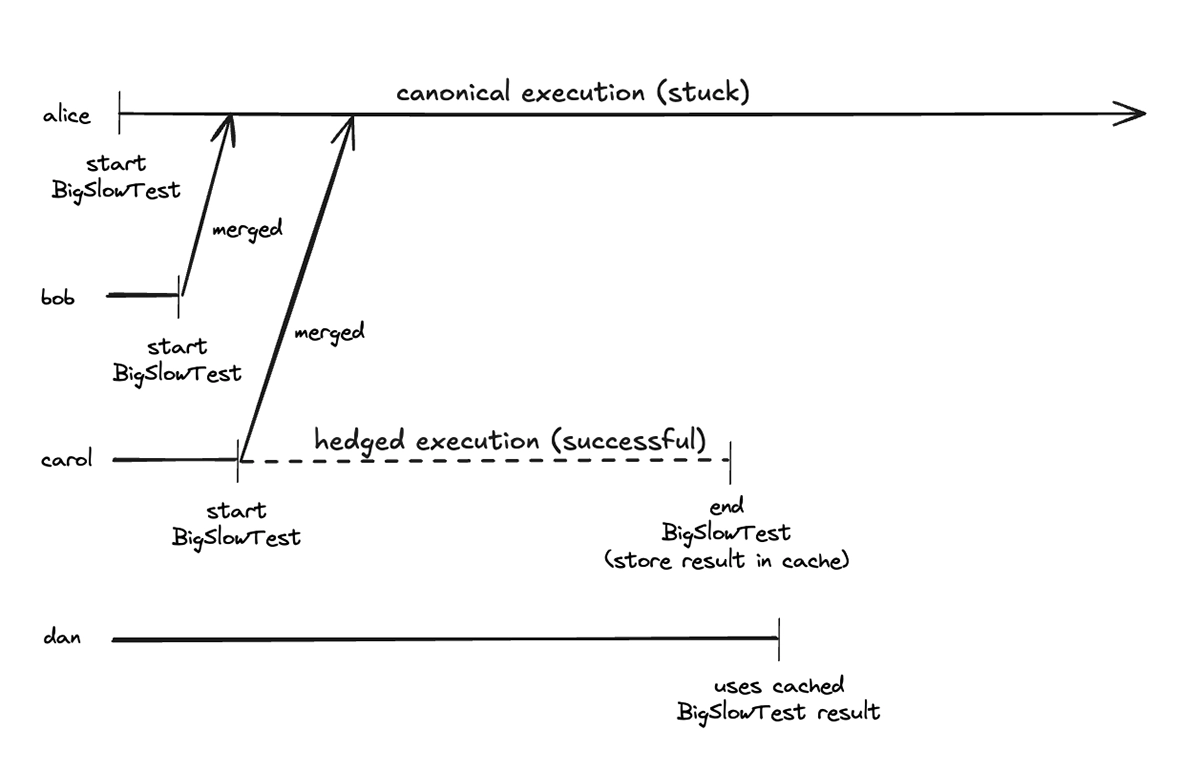 How hedging unblocks merges against stuck executions.
A Scaling Bug
When we added support for hedging, we also added a few metrics tracking action merging performance. We found that in the best case, hundreds of invocations merged against a single primary execution, and action merging saved hours for some invocations. This was encouraging to see! But over time, our metrics showed action merging performance decline. Initially, we chalked this up to different traffic patterns, but after digging in, Brandon noticed our action merging Redis client was configured to read and write action merging state from a single Redis shard instead of the entire Redis deployment. This meant that the effectiveness of action merging decreased proportionally as we increased the size of our Redis deployment. Whoops!
Fortunately this was an easy fix.
Future Improvements
I mentioned some fixes and optimizations above, like correctly reference counting merged invocations to improve the correctness of cancellation. But there are other enhancements we'd like to make to action merging too. First, one downside of action merging is that it can amplify the negative impacts of flaky tests. If a primary execution fails due to a flake, all merged executions will fail too. We would like to use the information we already have about flaky tests to merge and hedge actions more intelligently. Second, we would like to use the result of hedged executions for merged actions to unblock stuck executions, not just those submitted after the hedged execution finishes. Finally, we'd like to show a bit more information about action merging in the BuildBuddy UI.
Conclusion
Action merging saves our users time and resources by deduplicating identical in-flight executions of an action. But, like most distributed system designs, it's tricky to get right and there are some interesting corner cases. We hope this blog post helps you understand why this feature is important and how it works. If you want to learn more, we recommend checking out Christian Scott's talk on this topic at Bazelcon, 2024, Sushain Cherivirala's blog post on remote caching and execution optimizations, or reaching out via Slack or Email. And if you made it this far and found this interesting, we're hiring!